


In the last few years, we’ve all experienced a long overdue social reckoning with racism. To address it many nonprofit organizations have implemented diversity, equity, and inclusion (DEI) programs and tried to hire more BIPOC (Black, Indigenous, People of Color) staff. While this is important work and more needs to be done, unfortunately there is little evidence yet to show that these efforts have led to authentic and substantive change toward improved outcomes in nonprofit organizations. DEI committees, statements, and even policies are certainly a step in the right direction.
One reason for limited outcomes from these efforts is that they have softened the topic itself and uncomfortable discussions around it by bundling it all into a bumper-sticker of Diversity, Equity, and Inclusion (DEI). Instead, if we want to achieve authentic DEI outcomes, we need to talk about racism, identify it in our organizations, and address it systemically as a structural, procedural, and cultural issue.
The Premise
Of late, more is being written and discussed on the new needs from management in response to the social changes happening before our eyes. The premise of much of the writing is a need for change from a long tradition of authoritarian management to engage workers’ perspectives. While this is a great place to start undoing racism, more should be done to engage all organizational stakeholders.
At a recent session during the Washington State Nonprofit Conference, we attempted to tackle this challenge. Our premise started with the understanding that there are 3 expressions of racism: cultural, personal, and institutional. In nonprofit institutions we create new knowledge about how to apply anti-racism “at home” for and with the people in the sector. Using the premise that institutional racism is expressed when there is both bias and power.
Nonprofit Organizational Structures
First, we need to understand the traditional structure (for better or worse!) of nonprofit accountability and responsibility.

Some argue that hierarchical power structures are remnants of white supremacist structures. This perspective ignores the fact that clear delineation of authority, roles, and responsibilities is critical for any organization to function effectively. And while the abuse of this traditional organizational structure can promote outcomes incompatible with the principles of equity and inclusion, these outcomes can be avoided.
Power Dynamics and Governance
The power dynamics in organizations are complex and matrixed. Managing them can be tricky and requires trust and patience as well as urgency and accountability for anti-racist practices.
Given the hierarchical structure of most organizations, there are invisible power dynamics throughout. And, in order to address organizational racism, we need to see the invisible power dynamics across the whole organization between three key stakeholder groups of people in the structure. The three groups are:
- Constituents – clients, community leaders, donors, any non-employee
- Staff – Include ED/CEO and all others on payroll
- Board – Excluding ED, all other members
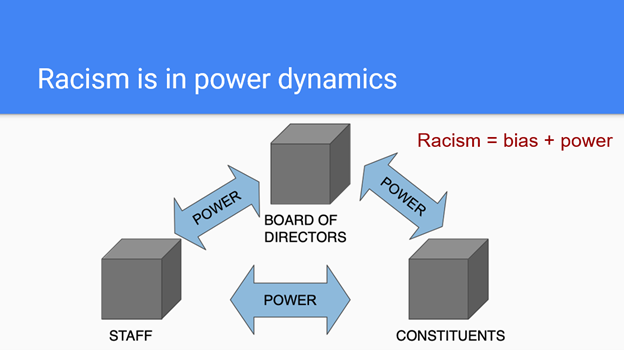
Regardless of what is on paper or in the laws, the reality is that power is wielded from all the stakeholders in an organization. We know that the board of directors has power, but staff also has power in its ability to deliver mission. Constituents (donors, volunteers, and recipients of services) also exert influence and power through their participation in the organization and their decisions of whether to continue involvement in the organization. Every member of all three groups is valuable to the organization.
After a quick review practice of identifying challenges from power between the three groups in nonprofit organizations, we quickly reviewed the characteristics of and the antidotes to white supremacy culture.
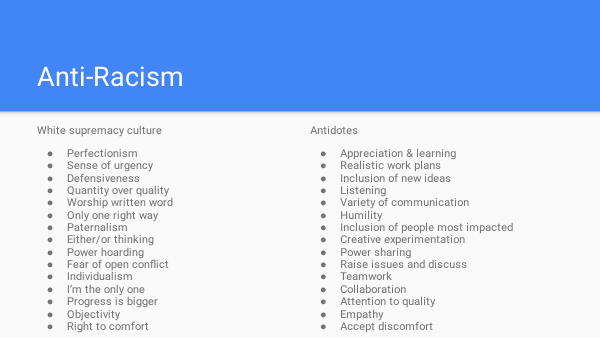
In the workshop we asked more than 100 participants to start engaging on identifying the problem based on the premise. We asked:
What are some of the organizational challenges that you’ve seen or experienced that might have been caused by white supremacy culture?
The discussion was enlightening (and frankly, frightening) in its revelations that the “problem” is so expansive that solutions all seem to address only part of the problem. A few realities quickly became clear:
- If we are going to change (as opposed to merely pointing out the problem) the workplace (within nonprofit organizations), we will have to move from just “calling out” the problem to a commitment to bring everyone along as we learn and change together.
- Prejudice does not present itself in one form or from one source. It is complex and rooted in both conscious and unconscious biases.
- It is not just people who perpetuate prejudice. Systems, traditions, even legal constructs are often either based on bias, or perpetuate it.
What leadership actions and antidotes to white supremacy culture could address the challenges?
- “Allyship” can be just as rooted in racism (for example, White Savior complex) as the racism they tend to point out!
- You may have heard the phrase, “All Politics is Local.” Well, the solutions that have proven to be the most impactful are those that are local, personal, and based in respect of individuals as opposed to focused on broad societal realities. In other words, efforts to change societal prejudice on a grand scale will always be less effective than efforts to genuinely believe that individuals are inherently good and worth the effort it might take to enlighten them.
- Racism and racist attitudes frequently are the result of unconscious bias. People may not think they are, or want to be, racist; but their actions come across that way.
Key Takeaway
An organization can only make true progress towards anti-racism when it addresses its shortcomings structurally, procedurally, and culturally. This means bringing on diverse voices at all levels of the organization, ensuring that processes are in place to allow these voices to be heard, and creating a culture that promotes collaboration and values differing perspectives. And, because anti-racism is aligned with effective leadership practice across all three elements we need to recognize the power dynamics and exercise effective leadership to move towards anti-racism.
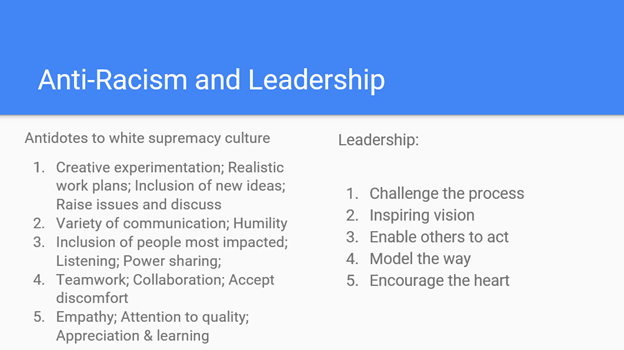
Successful initiatives typically follow this framework:
- See it – Make the invisible visible: Look for power dynamics across the organization in all their varying forms.
- Understand it – Collective learning about power consciousness:
- Address it – Co-creation of actions based on antidotes to white supremacy culture and effective leadership practices with all three key stakeholder groups
The overriding advice from the group was two-fold:
- Approach each other with respect and the assumption that people are inherently good and want to be and act in ways that support diversity, equity, and inclusion.
- Don’t shy away from pointing out problematic statements or behavior as an opportunity to help people recognize how their words or actions were received. As you help them find alternatives that help everyone grow and respect each other more fully.
The following resources are extremely valuable in aiding with education and self-reflection:
- The Four I’s of Oppression from the Chinook Fund
- The Dismantling Racism workbook from DismantlingRacism.org
If you need help finding nonprofit leadership that understands how to move your organization to an anti-racist culture in the nonprofit workspace, please reach out to us. We provide interim Executive Directors and offer nonprofit leadership recruiting services to match organizations with the kind of leadership that understands the fundamental worth of all people.